Pharmacovigilance Training Landscape in Korea
페이지 정보


본문

✔️ Where Does Pharmacovigilance Education in Korea Stand Today?
Pharmacovigilance (PV) is a core function ensuring the safe and effective use of medicines throughout their lifecycle. In Korea, PV training programs for pharmaceutical professionals are broadly structured into legally mandated education and public/private sector professional training programs.
Below is an overview of key regulatory mandatory training and publicly available PV education programs scheduled for 2025.
✔️ Mandatory Regulatory Training: Core Requirement for Drug Safety Managers
Under Article 37-3 and 37-4 of the Pharmaceutical Affairs Act and Article 47-2 of the Enforcement Rules on Safety of Pharmaceuticals, Drug Safety Managers are required to complete 16 hours of training every two years.
1) Program Overview
· Organizing institutions: Korea Institute of Drug Safety & Risk Management (KIDS), Korea Pharmaceutical Association (KPA), Korea Pharmaceutical Traders Association (KPTA)
· Format: Online / in-person / hybrid (varies by program)
· Fee: KRW 190,000 – 230,000
· 2025 schedule:
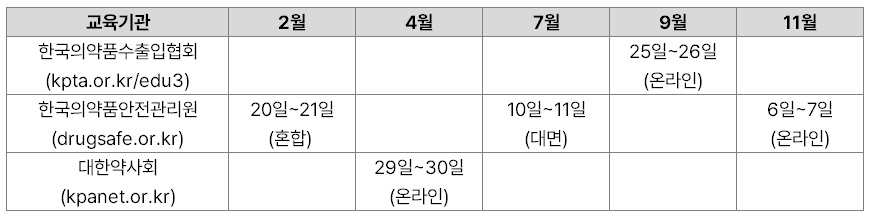
* Programs are generally divided into basic and advanced levels (KIDS)
2) Key Training Content
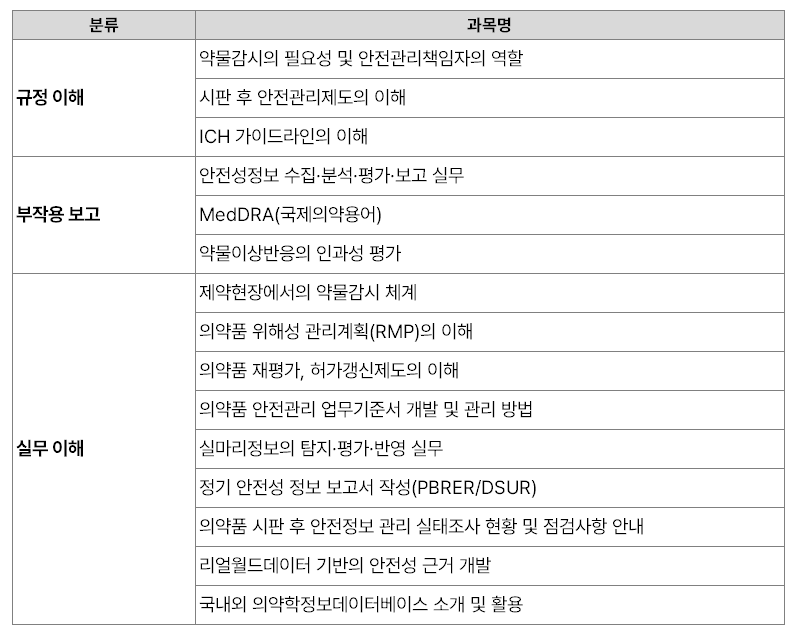
The program is designed to strengthen competencies of Drug Safety Managers responsible for post-marketing safety surveillance. Core topics include: Post-marketing pharmacovigilance systems, Adverse event reporting and management, Causality assessment of adverse drug reactions, MedDRA (Medical Dictionary for Regulatory Activities), Periodic safety update reports, Risk management plans (RMP). Content may be updated annually to reflect regulatory or industry changes.
<Key Course Modules for Drug Safety Manager Training>
✔️ Public and Professional Training Programs: Strengthening Practical PV Capabilities
In addition to mandatory training, Korea also offers a wide range of PV education programs delivered by regulatory agencies, clinical trial organizations, and industry associations.
Recent programs (H2 2024 – H1 2025) can be broadly categorized into regular training courses and thematic seminars. Regular courses are held annually, while seminars are organized flexibly based on emerging topics and industry trends.
1) Korea National Enterprise for Clinical Trials (KoNECT)
· Regular Training: Understanding Pharmacovigilance and Latest Trends (7 hours / 3 sessions per year)
Risk management planning
Benefit–risk evaluation and reporting
Safety information management for investigational products
· Seminars: PV Strategy Using RWD and RWE (4 hours)
Post-marketing safety assessment using real-world data
CDM-based PV analytics approaches
· Pilot programs (H2 2025 planned): Risk management, PV inspection and compliance review, ICSR processing hands-on training.
2) Korea Clinical Development Association (KCDA)
· Regular Training: PV Training Program (9 hours)
Overview of pharmacovigilance
Risk management plan (RMP)
ICSR processing
SDEA agreements and literature search
PBRER and DSUR preparation
Audit and inspection practices
· PV Practitioners Forum (Pilot) (4 hours, newly introduced in 2025)
Risk minimization measures
Self-inspection practices
· PV Auditor Course (Clinical Quality Management Division Seminar) (8 hours)
PV regulations
Audit planning and types
Affiliate audit experience sharing
Audit reporting and CAPA
Inspection findings
3) Sungkyunkwan University – Center for Regulatory Science in Pharmaceuticals
· Regular Training: Introduction to Pharmacovigilance (PV) for Regulatory Affairs (RA) Professionals (12 hours)
PV terminology and regulatory framework
Overview of pharmacovigilance systems
Spontaneous reporting, literature review, global ICSR processing
PV implementation practices
· Regular Training: Advanced Pharmacovigilance (PV) for Regulatory Affairs (RA) Professionals (12 hours)
Risk management plan (RMP)
PBRER and lifecycle updates
DSUR preparation
Case processing workflows
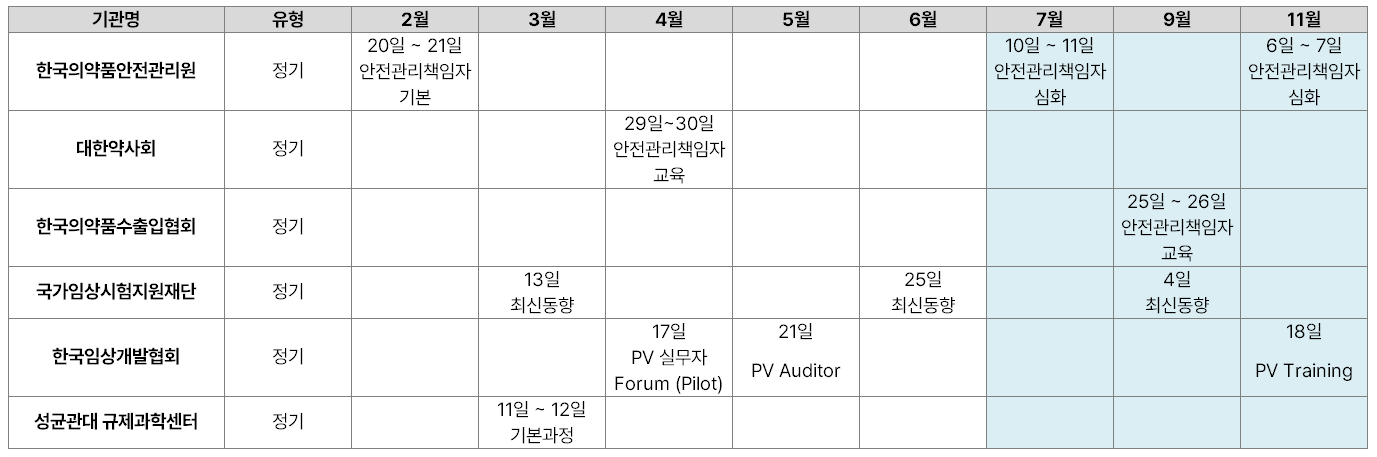
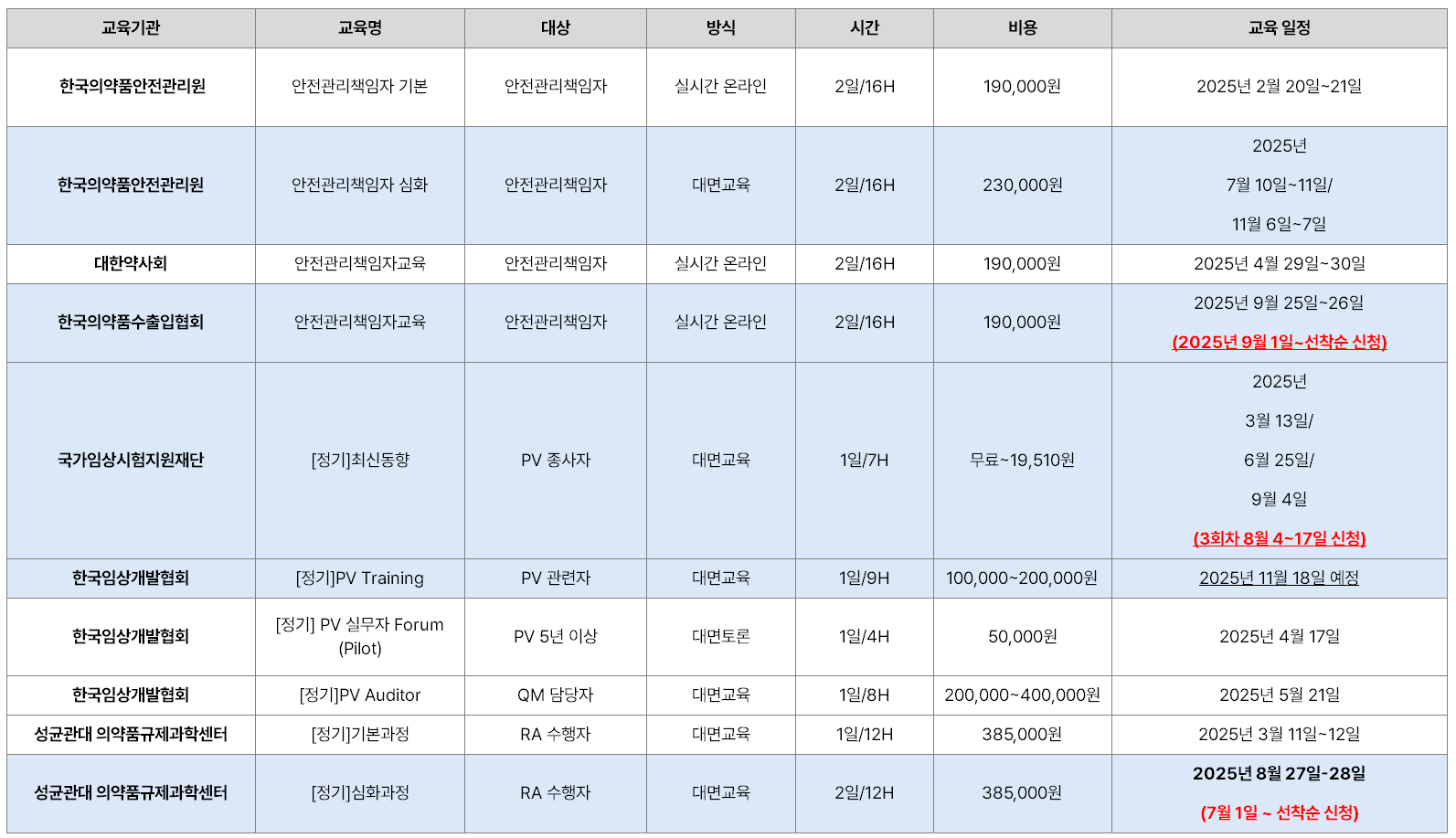
✔️ 2025 Pharmacovigilance Training Schedule
The following summarizes PV training programs conducted or planned by relevant institutions in 2025. This information is based on data as of July 23, 2025, and is subject to change depending on institutional updates.